Thursday, June 21, 2012

Do Your Work Heartily for the Lord

Day One

Add eight Americans, four Ukrainians, one translator, numerous support people, blood, sweat, tears, seven days, a desire to serve the Lord and the Spirit of God.


Day Seven
 

Any Questions?

Tuesday, June 19, 2012

Construction Team Update

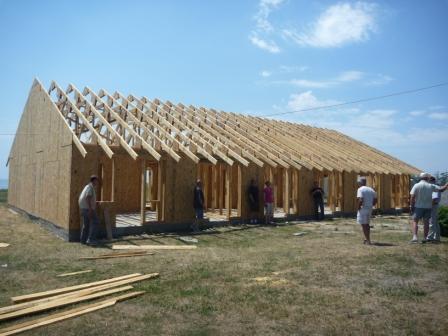
English Café is going well in the city of Odessa while the team continues to build at the camp.  Following are a few picture of the construction progress on Friday and Monday.


End of work day Friday


Friday


9:00am Monday morning


Lunch Monday


Monday 4:30pm.
That's a wrap!

Wednesday, June 13, 2012

Construction, English and Coffee

This year, June is going to be a very busy month.  Today is the 13th and we have already seen our son graduate from Ukrainian school, said goodbye to visiting grandparents, had several picnics, participated in Odessa Seminary graduation, greeted a construction from the US and had many planning meetings concerning academic programs for the future along with our normal day to day schedule.

This graduating group from Odessa Seminary is special to us because it is the first group that Alfie has been able to teach all three years.

Alfie and Julie with Bachelor of Theology Students at Odessa Theological Seminary Graduation


Currently a construction team of seven men and one woman from EV Free Fullerton, California is at the Black Sea Camp (about 40k north of Odessa), building a family dwelling structure.  Today is only day three of construction and we have seen great progress.  There are many Ukrainian youth and adults helping.
Day one Black Sea Camp construction planning.


Day one advanced group of the English Cafe
At the same time we are hosting an “English Café”at Grace Church in Odessa. So, Julie and the girls are in Odessa for the Tuesday, Wednesday and Thursday Café, Joseph is the translator for the team at the Black Sea Camp and Alfie is going back and forth. He is mostly at the camp but needs to come to Odessa to teach the Bible lessons at the Café.


Day one start at the Black Sea Camp


Early Day Two at Black Sea Camp
So far things are going great.  The first day of the café saw a large group of advanced English speakers.  Two days of construction at the camp saw three and a half bearing walls built and the first trusses already assembled.  We have ordered a crane for Monday. 

Alfie is in Odessa on Wednesday (day three) but the team is in good hands with Joseph as the translator.
Mid Day Two at Black Sea Camp

Friday, May 18, 2012

The Defense Rests

One of the strengths of the Bachelor of Theology program at Odessa Theological Seminary is that each student is required to write a final “Diploma Work” and defend it before a panel of faculty and peers.  The process is difficult and can be frightening.  I had the privilege this year of being the advisor to two students, Dima and Oleg.  This was a challenge to my Russian speaking ability; however we were able to communicate well in our weekly interactions.  Thankfully, they both read English well so, through the year, I was able to read their work in Russian and provide feedback in English.  About 10 days ago they both defended their work before their peers and a panel of faculty.  After working so hard together and seeing the great progress they both made over the year, it was difficult to resist the urge to defend them during the question and answer time.  However, in this case, resistance was not futile and they both produced a work to be proud of, gave excellent presentations and did an excellent job answering questions.  They needed not help from me defending their point of view.  Great job guys, I was a privilege working through these texts together.  You have earned a good rest.

Below are excerpts of my comments from my recommendation of their work.
Dima Trei studied John 6.  He wanted to know specifically what Jesus meant by “Eating My flesh and drinking my blood.”  More specifically, is it connected with communion and if not, what does He mean.

Comments:


Dima
After the analysis Dima presents his arguments in three parts.  First he presents the position that the passage is a reference to the Eucharist.  He gives a summary of the position then uses the position of orthodox theologian Георгий Чистяков as a test case.  Dima presents three arguments from Чистяков for the position that Jesus is making a reference to the Eucharist.  In the next section, Dima counters each argument and then presents at least four more of his own that explain why he rejects the connection with the Eucharist.  This is one of the strongest sections of the paper.  Dima makes good use of his historical and lexical analysis to build solid arguments that come from the text itself.  He makes an especially good argument against the nuanced use of the words εσθιω and τρωγω.  He shows how John clearly used them as synonyms in John 13:18.  This verse is a quote from the LXX text of Psalm 40:10.  In LXX the word εσθιω is used.  However, when John quotes it he uses the word τρωγω in the place of εσθιω.  This is a very strong argument that John did not use the words according to their nuanced meaning but as synonyms.


...After rejecting the Eucharist position, Dima present his own point of view in his Theological Interaction.  Here he combines what he has learned from especially his historical, lexical, rhetorical analysis to come to the conclusion that to eat the body of Jesus and to drink the blood of Jesus is to believe in Him for spiritual life in the same way you believe in real bread for physical life.  He uses the inlcusio to divide the passage into three parts.  The first is the exchange between Jesus and the Jews.  In this section, terms are being defined.  The Jews are talking on an economical level and Jesus on a spiritual.  Next is the first inclusio (6:35-48).  Dima calls this the key to understanding the third metaphorical section.  In summary, in this section Jesus connects the idea of coming to Him in belief with hunger and thirst.  There are more nuances, but Dima uses Jesus’ own words to explain the more difficult third section.  The third section is the next inclusio (6:49-59).  This is where Jesus explains similar ides using metaphorical language.  Dima connects the three sections to arrive at his conclusions and adds more nuances about being one with Jesus and reasons why He used such shocking language. 

Oleg Yakavenko


Oleg studied Paul’s view of the atonement.  He presented a range of ways Paul explained and expressed Jesus’ work on the cross and then focused specifically on the term ιλαστεριον (hilasterion) in Romans 3:25.
 
Oleg

…Next Oleg presents a solid grammatical analysis.  This is the strongest section in the work.  Oleg deals especially well with the problematic phrase δια πιστεως Ιησου Χριστου.  He gives a clear presentation of the grammatical nuances and how they influence the translation and meaning... In the rest of his analysis he brings out the nuances of various grammatical structures.

The lexical analysis of ιλαστεριον is well done.  Oleg follows a modified methodology from Gordon Fee’s book.  Along with other lexical works, he makes good use of BAGD and Louw and Nide’s Semantic Domains.  He presents the time period where the word appears regularly.  He shows its use in non-biblical material, then moves on to the LXX and the New Testament.  He ends with a range of meaning that includes 13 distinct uses.  In his analysis of the data he compares the reasoning mostly of Leon Morris, James Dodd and D.A. Carson.  In the end Oleg comes to the conclusion that “propitiation” is the correct translation.  He gives several reasons for this decision.  This is a solid lexical analysis, but what is missing is this.  It could not see his though process that shows how he eliminated the other 12 options.  I think that would have added a lot of richness to the analysis.  Oleg explains the thought process of Morris, Dodd and Carson but not his own.

…Next Oleg gives his personal translation, a theological interaction and some personal application and reflection.  This is well developed and I especially enjoyed his personal reflection.  I think these reflections would be especially effective in the sermon or Bible study.  He shows how solid scholarship can have a profound effect on the spiritual life of a person.  Well done!

Solo Dei Gloria!

Saturday, April 14, 2012

Grammatical Musings about the Resurrection


One of the things I like about living in Ukraine is the way the religious culture influences society.  As missionaries, we often speak of the evils of a religious culture.  It is steeped in ritual and not faith.  Some of the practices are a mix of biblical, traditional and pagan influence.  People are deceived into thinking that if they just do the right things, say the right words; they will be accepted into heaven.  These are all true things and we need to keep them in mind in every culture.  However, there are some benefits to living in a religious culture.  One benefit is that most people are theists.  Another benefit is that most respect the Bible.  Another benefit is Easter.  In Ukraine and Russia there is a tradition of congratulating each other on holidays and birthdays.  “I congratulate you on Christmas, your birthday, the first fall of snow, the first day of spring, etc.”  Some holidays, like Easter, have a special congratulation.  On Easter, everyone says, “Christ is risen” and the other answers, “He is risen, indeed!”  In Russian we say, “Христос Воскрес!” – “Christ is Risen” and the answer is, “Воистину Воскрес!”  - “He is Risen Indeed!”   We can say, “Christ is Risen” to any person on the street and they answer, “He is risen indeed!”  Now I understand that many don’t believe what they are saying or it is just a ritualistic practice.  But, as a believer, to hear the resurrection proclaimed everywhere and all day has a renewing effect.

This time of year people also often ask me how to say this in Greek, because if you say in Greek, you get a special blessing (OK, no more sarcasm).  This is a simple question, but I can usually find a way to complicate the answer to a simple question and this is no exception.   In the Greek Orthodox tradition the phrase is, “Χριστος Ανεστη!  (Christos Anestay) And the answer is Αληθως Ανεστη! (Alethos Anestay!)”.  In the original Greek, that means, “Christ is Risen!  He is Risen Indeed!”  The verb in this phrase is in what is called the aorist tense and indicative mood.  Pretty boring concept but bare with me, I have a point.  The typical purpose of an aorist is to describe an action without comment on type of action.  From the context an aorist verb can have different kinds of action but the tense itself is neutral.  The aorist indicative typically shows real action in the past and it is the typical way of describing the past.  So, from the grammar, Χριστος Ανεστη!  Αληθως Ανεστη! simply means that Jesus rose.  In the New Testament, this verb same verb is sometimes used to describe the resurrection and sometimes a different verb is used.  So, it is a legitimate way to say, “Christ is Risen!” 

However, the most common verb used after the resurrection, to describe the resurrection is εγειρω.  It has a different semantic domain than ανισταμι, but there is much overlap in meaning.  In other words, they can be used a synonyms.  This second verb is a favorite of Paul’s when writing about the resurrection.  What I find particularly interesting is the way Paul expresses the resurrection to the Corinthian church.  By the way, these thoughts are not unique to me.  I have heard them taught in Greek classes and commentaries, so I take no credit for the observation.  I only take credit for finding it interesting and encouraging.  Paul says to the Corinthian church that this is “of first importance” and then describes the Gospel.  Christ died for our sins according to the Scriptures and was buried and was raised on the third day according to the Scriptures (I Cor. 15:3-6).  The grammar here communicates at least as much as the words.  There are three verbs.  “Christ died.”  This is an aorist indicative verb.  No comment on type of action, just the typical way of expressing past tense.  “He was buried.”  Again, this is an aorist indicative – typical way of showing past time.  Then Paul changes tense.  He writes Χριστος εγηγερται (Chirstos egegertai).  This verb is a perfect indicative.  The perfect is flexible in use, but typically it is used to show a past action with lasting results.  This is especially true when it is used, as is the case here, in contrast to present or aorist verbs.  The idea is something like this:

·         Christ died for our sins.  Past event.

·         He was buried.  Past event

·         He has Risen! Past event with lasting results.  He is risen and remains alive today!

The first readers of this phrase were probably mostly first listeners as someone read to them, would have understood this powerful nuance implicitly.  The idea that the risen Christ remains risen powerfully jumps out from the grammar.  So, I like Paul’s version the best.  But that still leaves me with a bit of a dilemma.  When people ask, “How do you say that in Greek?”  I cannot give just a simple answer.  So I say something like this.  “Well, there are a number of ways.  The most popular is the traditional Greek Orthodox phrase "Χριστος Ανεστη!  And the answer is Αληθως Ανεστη!".  But those verbs are aorist tense and while being technically correct, there is a much more expressive way to say it.  Paul is much more expressive when he writes, Χριστος Ηγηγερται!  Αληθως Ηγηγερται!”  That is my usual intended or attempted answer, but in reality I have never gotten much past the word “but”.  However, you cannot cut off a blog, so there it is.  Χριστος Ανεστη!  Αληθως Ανεστη! Or Χριστος Ηγηγερται!  Αληθως Ηγηγερται!


Either way, He is Risen! – Remains Risen! And will always be Risen! Amen!

Thursday, March 29, 2012

Trusting God in Hard Moments

An article submission by Micah Mosse for ClubHouse Magazine.

Micah (in middle) with her brother (Joseph) and
sister (Anya) on the first day of School.
I'm an MK (missionary kid) from Ukraine, Europe.  I was almost four when my family moved here. My brother was six, and he was home schooled until 3rd grade when he went to a Ukrainian school.  I eventually started to go to a Ukrainian school, too, but I got a class with a teacher who had a loud voice. She used her loud voice often.  I "put up with" that school for two years, and then was home schooled for 3rd and 4th grade. After that my parents began to consider putting me back into public Ukrainian school. Because of the bad experience at the last school, I wholeheartedly disagreed. It was toward the end of August that I started to agree.  It was a day I was feeling particularly left out of the decision.  I think God spoke to me, and told me that this new school is what He wanted for me.

 
I’ll probably appreciate the decision when I’m 20, but, I have to admit it, right now, I’m having a difficult time. It has been a hard almost two years, but I learned some important lessons and have been strengthened by my faith in God.  I have nice friends, and some teachers are good and some not so good.  I am almost done with 6th grade, and my parents are thinking about sending me to a school designed for MK's! I don't know what our decision is going to be yet, but I'll leave it in God's hand.  Things seem to work out better when I do that!

Micah M.
12 years old

Saturday, December 3, 2011

Standard or Fluid Texts


Sometimes a good modern example serves to remind us of the importance of the “big picture” when we study ancient documents.  In a JETS article from March 2009 (Volume 52, No. 1)  – I’m a little behind in my reading, Peter J. Gentry wrote an excellent article called “The Text of the Old Testament”.  In the article he examines the history of the Old Testament texts, scribal practices, Ancient versions, discoveries and history of interpretation among other things.  In section IV, “Assessing the Witnesses and Reconstructing the Text History” he addresses the texts from the Judean Desert.  In his critique of Sidnie White Crawford, he makes an excellent observation that caught my attention.  After a study of the Qumran texts Crawford concludes that “…both canon and text were fluid and not standardized at this time.”  She means during the late Second Temple period the Old Testament texts were still fluid.  Gentry does not agree, but also does not discount the evidence.  In footnote 66 on page 37 he says this:

In many ways, the history of the biblical text at this time is not dissimilar to a Christian or Jewish bookstore today.  One wonders what an archaeologist would conclude after excavating remains of a contemporary Christian bookstore some 2000 years hence.  The number and variety of translations of the Bible is bewildering to people today, not to mention some future historian of the text.  Here are some examples of what one may encounter:

  • The New Student Bible
  • Life Application Bible (Take the Next Step)
  • Psalty’s Kids’ Bible
  • NIV Young Discover’s Bible
  • The Adventure Bible
  • The Full Life Study Bible
  • Disciple’s Study Bible
  • Women’s Devotional Bible
  • The Family Worship bible
  • The Devotional Bible
  • Youth Bible
  • The Discover Bible
  • The Daily Bible
  • The One Year Bible
  • The Spirit-Filled Life Bible
  • The Orthodox Study Bible
  • Rainbow Bible
  • Precious Moments
  • Mother’s Love N.T. and Psalms
The same categories used to classify texts at Qumran exist in Bible editions currently published:  Bibles that offer a standard text unadorned and uninterrupted and Bibles that adorn and decorate, paraphrase, interpret, and re-arrange the text for the audience and culture of our times.  Do we conclude from this that both canon and text are fluid? Hardly.

His point is with reference to the development of the Old Testament text.  However, in my view, the principle can be applied to our study of any ancient text or tradition.  It is an excellent reminder that our analysis of historical texts, be they epistles, gospels, inscriptions or whatever, must be seen against the background of the historical and sociological context.  In other words, we must remember the big historical picture.  Thank you for the reminder professor Gentry!