Sunday, September 2, 2012

When You Disagree with the People’s Translation – Part III of III

Old Church Slavonic (18th Century)
Now that I have convinced myself which text is original, I see a more daunting task before me.  If I am to teach this in a Russian or Ukrainian context, how do I teach the text without undermining the authority of the people’s Bible?  If I simply tell them to trust me, I am undermining the authority of their Bible and making myself their authority.  I don’t want to do that.  If I try to explain how I came to this conclusion, I will lose most of them and bore the rest to death.  So how do I teach/preach what I am convinced is the original text and at the same time support the authority of the people’s Bible?

Here are some suggestions.  The following suggestions are given under the assumption that the teacher/preacher prayerfully and humbly prepares his messages with a desire to communicate God’s truth in a way that will bring glory to God and transform the hearts, minds and lives of his listeners.  A high standard I know, but the calling to teach/preach God’s truth should, in my view, always be approached with awe, fear and trembling.

First, do your homework.  To the extent that God has given you the ability, study the issue.  This is also an opportunity to perhaps increase and improve the exegetical skills God has allowed you to develop. 

Second, study the issue from different points of view.  One way to do that is to read people you don’t agree with and even learn their position well enough to defend it.  One professor used to say, “You are not ready to debate an opponent until you can skillfully defend your opponent’s position.” 

Third, be able to explain your view in terms that the non-seminarian can understand.  This is not easy.  Not everything can be explained in simple terms.  This will take time and may require a willingness to further educate those who ask.  You should think this through as part of your message preparation.  You should be prepared to define terms and point people to resources for further personal study.
Fourth, consider your audience, your verbal genre and your explanation.  For example, if your preparing a sermon that includes Romans 8:1, you are going to have to say something about the textual issue.  If your audience is a small congregation of elderly people living in a village in rural Ukraine, it is probably a bad idea to go into a lot of detail about the study of textual criticism.  However, it may be helpful to say a few words about the nature of translations.  There is sometimes disagreement on how to translate certain Greek or Hebrew terms.  Always humbly affirm that there are good reasons for the decision that the translators of the Russian Bible (for example) made and while you respect their scholarship, on this one point you don’t agree.  Explain your conclusion and then offer to explain further after the service if someone has more in depth questions.  I think this is enough.  It affirms the usefulness of the people’s Bible while at the same time reminding them that it is a translation and in all translation something is lost.  It also indicates the humble possibility that you could be wrong (and it’s true, you could be wrong) and the translation could be correct.  On the other hand, if you have an audience of seminary students and staff, it may be useful to spend a little time on the textual issue and show how the discipline can be used in the exegetical process.  I think it is a good idea to try to include, on some level hermeneutical and/or exegetical principles – directly or indirectly in every sermon.  It may also serve as an opportunity to stretch and inspire your hearers to further study.

Finally, consider your time constraints.  The textual issue is important, but you don’t want it to obscure the more important truth that there is no condemnation for those in Christ Jesus.  Remember, if some have questions, there is always time to have a mini seminar or informal discussion group after the sermon.

It is my sincere hope and desire that these musings help some better study, understand and communicate the Word of God.

Wednesday, August 29, 2012

When You Disagree with the People’s Translation – Part II of III


Before making a final conclusion about Romans 8:1, we must consider the internal evidence.  These are sometimes called Transcriptional Probabilities and Intrinsic Probabilities.  I will consider four points with respect to internal evidence. 

·         Prefer the shorter reading. Reading 1 is the shorter reading.

·         Prefer the more difficult reading.

·         This is obviously a bit subjective but in a passage that emphasizes walking in the Spirit and the abiding presence of the Spirit in the believer as a sign of belonging to Christ, reading one seems to be the more theologically difficult.

·         Prefer the reading that best accords with the authors style and vocabulary.

·         This could be either reading one or three because the exact same phrase is used in 8:4.  Below, this becomes a powerful argument for reading one.

·         Prefer the reading that best fits the context and the author’s theology.

·         This is a real debate.  Is Paul saying that there is no condemnation for those in Christ Jesus or no condemnation for those in good standing in Christ Jesus?  This does not give us much help because one could make a theological argument (highly nuanced of course) for either position.

Second preliminary conclusion:  The external evidence points to reading one as original.  The internal evidence seems to me to be a little ambiguous.  Reading one is shorter and more difficult, however, the longer readings could accord with the author’s theology and style.  So at this point I am leaning toward reading one, but I am not entirely convinced.

After considering the above evidence there is one more “watershed” principle that needs to be considered.  In my experience, this is often the principle that convinces me which reading is original.  Prefer the reading that best explains the origin of the other readings.

Reading one seems to best explain the rise of the others.  It is easy for me to imagine why a scribe would add the words “who do not walk according to the flesh but according to the Spirit.”  Without that phrase, it could be understood that Paul is saying that character change is not important with respect to salvation.  Of course that is not what he is saying, but, if someone wanted to make it clear that Paul is not talking about “fire insurance”, I could see how adding this phrase would solve the problem.  I can also see why a scribe would think himself justified in adding the phrase.  The exact same phrase appears in 8:4.  In taking the phrase from the near context of verse 4, the scribe could see himself clarifying the meaning without violating the writing style of the apostle.  Early scribes tended to clarify the text rather than make them more ambiguous.  In the same line of reasoning, if the phrase were part of the original text, it seems hard to imagine why a scribe would remove it.  Removing the phrase makes the meaning of the passage more ambiguous.  If we accept the premise that scribes tended to clarify texts then it would be highly unlikely that a scribe would remove either phrase two or three if they were original.  Therefore, based on the above arguments, I conclude that reading one is original.
 
Now that I have convinced myself which text is original, I see a more daunting task before me.  If I am to teach this in a Russian or Ukrainian context, how do I teach the text without undermining the authority of the people’s Bible?  I will offer my musings about this question in part III.

Monday, August 27, 2012

When You Disagree with the People's Translation - Part I

When you are convinced that a passage in a popular translation of the Bible is incorrect and the truth is seriously altered by the decision of the translators, how do you teach/preach that passage without undermining the authority of the people’s Bible?  Romans 8:1 offers a good example.

When dealing with textual variants in the New Testament, one of the first questions I like to ask is this.  “Does the variant reading seriously alter the meaning of the text?”  In many cases the answer is no, so there is no need to do a detailed textual analysis and we accept the judgment of the translation committee.  However, there are some variants that do significantly alter the meaning of the text.  Romans 8:1 is one of those texts.  According to the UBS 4th edition apparatus, Romans chapter 8, verse 1 has three possible readings.

·         The first reading is the text accepted by most English translations.  “Therefore there is now no condemnation for those who are in Christ Jesus (NASB)”.  The sentence ends with the words εν Χριστω Ιησου …in Christ Jesus.”  This is the choice of both the UBS 4th and the NA27 editors.  The UBS 4th edition gives this reading a “B” rating.  That means that there was probably one dissenting voice on the committee.

·         There second reading contains the additional phrase “…μη κατα σαρκα περιπατουσιν …who are not walking according to the flesh.”

·         The third reading contains the additional phrase “...μη κατα σαρκα περιπατουσιν αλλα κατα πνευμα…who are not walking according to the flesh but according to the Spirit.”  This is the majority text reading and the reading found in translations like the King James, Russian Synodal and some Ukrainian translations.

Either of the additional phrases found in readings two and three significantly changes the meaning of the sentence.  If the first reading is the correct reading then it is simple a fact that there is no condemnation for those who are in Christ Jesus.  I realize that the theology of reading one needs to be developed in the context of Paul’s argument in the entire letter.  I understand that this is more than a proverb or pithy statement.  However, that is a question of exegesis and here I am focusing on the textual question.  If either reading two or three is original, Paul is saying that freedom from condemnation is dependent on our spiritual walk and obedience.  In other words, the truth is conditional.  If we are walking according to the Spirit and not the flesh then there is no condemnation for us.  But if we are walking according to the flesh, then there is condemnation waiting for us.  By implication, as we live our lives and struggle to follow Jesus, we enter into and fall out of favor with God and have no assurance of final salvation.  That is what I call a significant difference in mean.  Reading one, there is no condemnation.  Readings two and three, there is condemnation.

Since the variant has a significant impact on the meaning of the text, we must determine, as best we can according to the gifts God has given us, which reading is original.  How do we do that?  This is a debate about methodology, but I recommend and try to practice the “Reasoned Eclecticism” approach.  This approach tries to take in to account a wide spectrum of evidence (for example, the manuscripts we posses, the dates and numbers of those manuscripts, the quality of the manuscripts, the date of the reading, the geographical dispersion of the readings, early translations and versions, patristic quotations, the author’s style and argument, etc.) and analyze it in a reasonable and balanced way.  Below is my attempt at a reasoned eclecticism approach to this reading. 

We start with the external evidence.  We look at the manuscripts, their dates, quality, geographical distribution, text type, etc.  Table 1 below shows the manuscripts we posses, categorized by text type.


Following the methods of Metzger, Black and others, I will highlight four points with respect to the external evidence.
·         Prefer the reading attested by the oldest manuscripts.

·         Since we have no papyri, the oldest manuscripts are the uncials Aleph and B.  Both date to the fourth century.

·         The second hand of Aleph is represented in the third reading.  That means that sometime after the fourth century copying of the manuscript, a scribe “corrected” the manuscript and added reading three.  So reading three could also be very early.  However, thanks to modern technology and the Codex Sinaitics Project, I was able to see a digital reproduction of the page.  At first I could not find the correction.  The text seemed to be a clear witness to reading 1.  But it seems, it is difficult to read, that the correction is located at the top of the column in a different hand (see photo below).  This could be a correction or simply a scribal note.  This seriously weakens the witness of the second hand of Aleph.

Siniaticus folio 263b, Romans 6:23-8:5 from http://codexsinaiticus.org/en/
 
·         Prefer the reading supported in the most widely separated geographical areas.

·         This is no real help.  All three readings are represented by manuscripts that were spread across the Roman Empire.  Therefore, all three readings enjoyed early acceptance in different geographical areas.
 
·         Prefer the reading supported by the greatest number of text types.

·         All three readings have witnesses in each of the text types.  However, reading one seems to have more of a balanced or wide spread representation of all three text types.  Reading two is heavy in Byzantine and Western text types with very little representation from the Alexandrian.  Reading three is almost exclusively represented by the Byzantine text type.  So, while all three have witnesses in each text type, the scale tips toward reading one.

·         Make a distinction between date of reading and date of manuscript and prefer the earliest reading.

·         The earliest reading is represented in Aleph and B, which most agree dates back to the second century.  These two manuscripts support reading one.  However, there are also old Latin witnesses for all three readings.  This means that all three readings were most likely known as early as the second century.  This is good evidence for the early existence of the variant.  However, the Old Latin versions were not professionally copied or checked and therefore do not have the weight of manuscript like Sinaiticus, Vaticanus or Alexandranus.  That said, we do seem to have more Old Latin witnesses for the first reading, thus tipping the scales toward the shorter reading.

Preliminary Conclusion:  Based on the manuscript evidence alone, the agreement of Aleph, B, a number of Byzantine witnesses, Old Latin and early Fathers forms a strong case for the shorter first reading. 
 
Before making a final conclusion about Romans 8:1, we must consider the internal evidence.  These are sometimes called Transcriptional Probabilities and Intrinsic Probabilities.  I will consider four points with respect to internal evidence in part II.

Friday, June 29, 2012

...but the Lord directs his steps

One of the signs of stress.
A person plans his way, but the LORD directs his steps. Proverbs 16:9 (ISV).  So goes the familiar proverb.  June has been a very busy month for us.  We knew it would be busy so we prepared ourselves.  We had lists:  train and bus tickets to buy, supplies for teams, presents for graduates, arrangements for guests, arrangements to be guests, etc.  At the beginning of the month we had all our plans in place and this proverb was ever in my mind.   I expected that even though I had planned our way, the Lord would allow unexpected things to occur that would change our plans and we would have to, by faith, allow Him to direct our steps.  This is how I understood the proverb.  Surprisingly, almost all our plans have gone “according to plan.”  It has been a hard month and I have been waiting and looking for the “curve ball” but it didn’t come. 

The part of our June plan that I was most worried about was our visa situation.  We needed new visas soon.  Through May and the beginning of June we gathered the necessary documents and made “plans”.  We had never gone to Moldova to get visas before, but understood that we could get them in two days.  I talked to the embassy and they said that they work on Mondays, Wednesday s and Thursday.  If we apply for a visa on one of those days, we can get it the next working day.  OK, so here was the plan.

Weekend:  Travel to Kiev, pick up Anya from camp, leave Joseph and Micah at camp.
Monday: Julie, Alfie and Anya travel back to Odessa.
Tuesday: Leave Anya with Brittany and Julie and Alfie travel to Chisinau to apply for visas.
Wednesday:  Arrive early at embassy and apply for visas.
Thursday: Pick up visas and take bus back to Odessa.
Friday: Travel to Kiev to get Joseph and Micah from camp.

We knew that because of the status of our current visas that we may have problems at the border crossing into Moldova.  We also knew that if we had problems in Moldova, that we could not come back to Ukraine without a new visa for 90 days.  We decided to pray and take the risk.  Our attitude was something like, “Here is our plan Lord, please make it work.”  Everything went fine until Wednesday.  The border crossings were no problems.  We thanked God for giving us favor in the eyes of the border guards.  We got a room near the embassy on Tuesday evening.  We found the embassy so we could easily get there the next morning.  We had documents and copies of documents. 

Wednesday morning comes and we arrive at the embassy a half hour before it opens.  There is already a large group waiting.  We add our names to the waiting list, we are 49 and 51.  OK, a little stress.  We should have come earlier, but we have all day to apply.  I pray, “Lord please let the line go quickly and efficiently.”  I walk around to relieve the stress and notice a paper taped to the embassy door.  It is in Ukrainian so it is a little hard to read.  I read it and understand it, but spend about five minutes trying to convince myself that I don’t understand the Ukrainian and everything will be alright.  The sign says that the embassy will be closed on Thursday…that’s tomorrow!  That means that we won’t be able to pick up our visas until Monday!  OK…stress level increases and I start making plans in my head.  I can beg the embassy to issue the visa today…but…but we are number 49 and 50… “Why didn’t we come earlier?”  Stress level increases more.  I’m angry at myself for not coming earlier.  What if we don’t get in before the break at 12:30?  OK…start to pray.  “Lord, please, please, please make all these people go away!”  That was a panic prayer.  “OK Lord, sorry for panicking.  I have two prayers.  Please let us apply in time to get our visas today and help me not to stress and say anything stupid to my wife.  Help me to trust you Lord.”  I think and plan some more.  It is time to put plan B, C and D on standby and began formulating plan E.  I talk to Julie.  “So, what is the backup plan?  Who will pick up the kids if we are stuck?”  There is a plan, but I don’t want to be stuck!  “Lord, I don’t want to be stuck.”  Plan some more…John can pick up the kids and they can stay in Kiev, or maybe he can send them to Brittany or Leah on a bus, maybe Igor is in Kiev and he can drive them down to Odessa.  We will need some more money for the hotel…”Why or why didn’t I come earlier?  How did I miss that tomorrow is a holiday?  Why do these people celebrate so many holidays?!  Don’t they know that there is work to be done?!  Why are there so many stupid holidays?  They only work three days a week and they are taking one day off?  What is the matter with these people!?”  (OK, not very fair...calm down, breath…..breath again).  Stress level increases…I’m on the edge….”Lord help me not to snap and say or do anything rash.  Help me to trust you”…more thoughts running through my head, more prayers….

I look at Julie.  She looks calm.  She turns to me and says, “Do you think we will have clothes in heaven?”  In my mind my head explodes.  My vision blurs.  Time stops as I try to absorb her question and the calm look on her face while our hopes of getting a visa this week slip into the abyss.  Praise God, I hold my tongue.  However, I guess in that instant, my face communicated much to Julie.  She simply says, “Oh, you’re worried about the visa?  The Lord will work it out, but I’ll let you be.”  She is not worried!  This makes me mad and embarrassed at the same time.  “Why isn’t she worried?”  OK…pray…think….plan.  How about walk a little.  …walking… “Lord, this is not the worst thing in the world.  We have friends, we have help.  Help me to accept whatever plan you have for us.”  I walk around a little more.  It is a little after 10:00am and the guard comes out yells, “Who is here for visas?”  What!  That’s us.  I raise my hand and head for the gate.  Julie didn’t hear him.  She is calmly sitting on a bench and reading.  I call her and say her we can go in.  She looks surprised and heads over to me.  As we go in, I notice that we are going in out of order. 

When we get in, we fill out the necessary forms and stand in line.  I have all the arguments ready.  “Please sir; if you could issue the visas today we would be very grateful.  You see our daughter is in Odessa and our other kids are in Kiev.  We can’t wait until Monday.  I know you are not working tomorrow.  Perhaps we could just pick up the visa in the morning….pause…perhaps there is an extra fee to expedite visa service.  We are ready to pay extra.”  We get to the window and the man says, “You want these today…right?”  Time stops...again the vision blurs….sound stops…those words were like manna from heaven.  There is a flash of blue light and I’m back at the window.  “Uhhh….yes, yes of course that would be great.”  “No problem” he says.  “Pay for the visa at the bank and come back after three.”  “Yes, yes, thank you so much.”  We leave for the bank, but the Lord is not done with us.

As we leave the gate, a young man says, “You guys buying visas?”  “Yep”, we say as we pass him to go to the bank.  We pay for the visas and return to the embassy to drop of the receipt.  When we return we start talking to the young man.  He is an American named Ethan who is also trying to get a visa to return to Odessa.  He is an independent missionary who works mainly with orphans.  He has his documents but is number 72 on the list.  We talk.  He asks what the sign on the door means.  I tell him that the embassy is closed tomorrow and will not be open again until Monday.  I watch as he takes the news very well.  He doesn’t seem stressed.  (I’m a little embarrassed at remembering my earlier reaction.) We ask the guard if Ethan can get in to do his visa.  The guard says that he doesn’t know.  There are a lot of people applying for visas.  About 12:45 we are waiting with Ethan and a man comes out and says that is all for today, everyone else will have to come back on Monday.  Ethan is disappointed, but takes the news well…again.  A discussion at the gate starts and intensifies and the guard agrees to take 10 more people and the rest will be first on Monday.  He takes 10 more and that takes him to number 71.  Ethan is disappointed but takes the news well…again.  He has to stay until Monday.  As he is getting ready to leave and another man says, “Come on…Take the American kid.”  The guard asks, “Do you need a religious visa?”  Ethan says yes and the guard motions him in.  We ran into Ethan again later and were able to help him get some extra documents.  We all got our visas and traveled back to Odessa the next day together on the train.

The Lord not only changed our plans, He improved them.  We got our visas faster than we planned and the embassy still got their holiday.  More importantly, through the examples of my wife and this young man, the Lord showed me how little I trust Him.  My instinct is still to fix it myself.  Yes, I pray but my blood pressure still increases, my mind goes to plan B, I try to fix it myself and take over.  I don’t mean that we don’t need to plan, but what I need to do better is “rest in Him when the plan changes.”  Really, I need to rest in Him all the time.  We (I) should still plan our way, but on the road, it is always best to let Him direct our steps.  I am honestly a little embarrassed but thankful for His lesson.

Thursday, June 21, 2012

Do Your Work Heartily for the Lord

Day One

Add eight Americans, four Ukrainians, one translator, numerous support people, blood, sweat, tears, seven days, a desire to serve the Lord and the Spirit of God.


Day Seven
 

Any Questions?

Tuesday, June 19, 2012

Construction Team Update

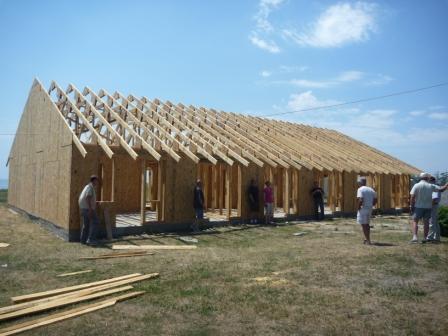
English Café is going well in the city of Odessa while the team continues to build at the camp.  Following are a few picture of the construction progress on Friday and Monday.


End of work day Friday


Friday


9:00am Monday morning


Lunch Monday


Monday 4:30pm.
That's a wrap!

Wednesday, June 13, 2012

Construction, English and Coffee

This year, June is going to be a very busy month.  Today is the 13th and we have already seen our son graduate from Ukrainian school, said goodbye to visiting grandparents, had several picnics, participated in Odessa Seminary graduation, greeted a construction from the US and had many planning meetings concerning academic programs for the future along with our normal day to day schedule.

This graduating group from Odessa Seminary is special to us because it is the first group that Alfie has been able to teach all three years.

Alfie and Julie with Bachelor of Theology Students at Odessa Theological Seminary Graduation


Currently a construction team of seven men and one woman from EV Free Fullerton, California is at the Black Sea Camp (about 40k north of Odessa), building a family dwelling structure.  Today is only day three of construction and we have seen great progress.  There are many Ukrainian youth and adults helping.
Day one Black Sea Camp construction planning.


Day one advanced group of the English Cafe
At the same time we are hosting an “English Café”at Grace Church in Odessa. So, Julie and the girls are in Odessa for the Tuesday, Wednesday and Thursday Café, Joseph is the translator for the team at the Black Sea Camp and Alfie is going back and forth. He is mostly at the camp but needs to come to Odessa to teach the Bible lessons at the Café.


Day one start at the Black Sea Camp


Early Day Two at Black Sea Camp
So far things are going great.  The first day of the café saw a large group of advanced English speakers.  Two days of construction at the camp saw three and a half bearing walls built and the first trusses already assembled.  We have ordered a crane for Monday. 

Alfie is in Odessa on Wednesday (day three) but the team is in good hands with Joseph as the translator.
Mid Day Two at Black Sea Camp